Showing posts with label leather. Show all posts

Thursday, 12 November 2020

An Exercise in Stitching - What I Learnt Making a Cricket Ball Wallet

 One of my first private commissions was something a little different to the stuff I usually make.

A friend of the family, artist James Nunn is a huge cricket fan and had always wanted a cricket ball inspired wallet.

I spent a few diverting hours researching cricket ball stitching and was almost immediately sucked down a rabbit hole reading up on the lost art of handmade cricket balls. The industry died out in the UK many years ago. Almost all modern balls are made in Pakistan - though still hand sewn whilst the ball is held in a spherical vice to raise the seam.

I then set about looking at different wallet designs. You'd think a wallet is just a wallet, right? Well, there are a myriad of different design options.

Once I'd decided on a couple of different patterns,  a bi-fold and a tri-fold, the next step is a test build. This is the wallet you see below - made from a bag of scrap panels I picked up from Artisan Leather. The soft creased leather was beautiful, and the wallet looked even better on the inside lined with soft pig-skin - an extra piece of finishing that I thought suited the wallet.

The test make


Pig skin suede lined cash slot adds an extra level of finishing

The main aim was to practice the cricket ball stitch and experiment with thread size and stitches per inch - I ended up buying an old cricket ball to study the stitching.

As nice as the test build was, I ended up gong for the longer tri-fold design for James's wallet; I really wanted to show off that stitching. I also changed leather, appropriately enough to a Wickett & Craig burgundy harness. The shine on this leather is just beautiful, it replicates the shine of a ball perfectly. I sourced two panels from the fantastic Beamhouse Leather - if you're looking for high quality panels of leather that are hard to get in the UK Jared is your man.

Leatherwork can be unforgiving sometimes. It's not like textiles, where a stitching line can be undone and re-sewn - each hole is hammered in with a stitching chisel and there's no going back. You have to be careful not to go wrong or scratch the leather.. harness leather is not cheap. So, my morale dipped a bit when I did exactly the latter on the outer shell that I'd just spent ages marking out seven parallel lines on with wing dividers and chiselling.

Stitching Lines

All the stitch lines..

Once I'd had a word with myself things went smoothly. Saddle stitching is actually pretty straightforward, the trick is consistency of movement, repeating the same exact action over and over again. Once you develop the muscle memory you can work pretty quickly.

I do have a heavy duty sewing machine but I choose to work by hand with leather, the results are just so satisfying. It's as much about the process of making and the necessary research as it is about the finished article. That is one of the reasons I enjoy commissions so much.

Best of all I got to hand the wallet over to James in person over a cold pint in pub in Bath (pre Lockdown 2.)

If you'd like something commissioned do get in touch. If you're a cricket fan the first wallet I made is available here.

Check out James's amazing artwork here.

Thursday, 23 October 2014

Your New Winter Boots - The Chippewa Homestead

Born in the USA

For me there is something about tan leather and denim that works seamlessly, and I love a work-wear inspired boot. 

So, when I was offered the chance to review a pair of Chippewas for work the Homestead Boot in Copper Caprice grain leather was a natural choice.


Chippewa Homestead Boot


Founded in 1901, the American brand Chippewa started out producing rugged work boots – a rich tradition they have kept very much alive in their Original Collection – one characterised by, to quote the press blurb, 
“a blend of modern durability found in contemporary outdoor products combined with the heritage and authenticity of American craftsmanship and work ethic. The Collection is an assembly of vintage-inspired footwear for individuals who appreciate classic boots with a distinctive identity.”

These boots were made for walkin'...

Chippewa Homestead Boot
Fresh out the box a few months ago.
As you'd expect from any heritage collection quality and craftsmanship are key - all the Original Collection boots are Goodyear welted, hand crafted in the USA using quality hides.

Well, to the Homesteads. The light tan grained leather has pleasingly soft texture to it, and unlike my Red Wings, the boots were comfortable straight out the box, requiring only minimal breaking in. No blisters for me, I'm pleased to report.

The cushioned insole is a nice touch, the heel being maple leather, the rest something called texon. (I have no idea..)

As befits what is technically a work boot there is a reinforcing steel shank. Yet, the boots do not feel too clunky.

After a few months of regular wear the boots are now moulded perfectly to my feet.

Chippewa Homestead Boot
Starting to age nicely.

Booty call

The detailing is stylish too – the unbleached cotton stitching across the toe-cap and round the outsole looks great. The 3 brass speed hooks at the top of the boots and waxed laces mean they’re easy to get your feet in and out of – important in Danish homes where forgetting to remove your footwear results in much social awkwardness.


The sizing comes up a little large, but I prefer to wear thick socks with my boots. 

The Vibram V-Bar sole does have some grip – whether that’s up to the rigours of a Scandinavian winter remains to be seen, though I’m sure they’ll be perfect around town. (For the woods we all have our hiking boots, right?)

Chippewa Homestead Boot
Absolutely love the stitching on these boots..

You've got sole

The Homestead boot might wear its heritage on its sleeve, however, whilst the construction is undoubtedly robust, the boots are not overly heavy. They could easily be used for a pair of ‘best’. So, if you’re looking for a quality light winter boot the Homestead is for you.


Chippewa Homestead Boot


As well as style the key thing for me comfort - and these babies are so comfortable I’m sure they’ll be keeping my feet nice and toasty throughout the winter. 
With this collection Chippewa set out to combine timeless silhouettes with modern style, and with the Homestead I'd argue they've succeeded.

Call me cynical, but when you add the tag 'original or 'heritage' the price normally takes a massive hike north.
The good news is that Chippewa have a considerably lower price point that the likes of Viberg & Red Wing - being owned by Justin Brands, one of the largest bookmakers in the U.S, means that Chippewa, for the Original Collection at least, are able to keep production in-house and remain competitive without the normal quality fall off you'd expect from a mainstream brand.

Chippewa Homestead Boot
More stitching porn..
A pair of Homesteads will set you back approx $260. (By way of comparison I paid that in GBP for my Red Wings. I find myself in the Chippewa's more..)

If tan leather is not quite to your taste the boot is also available in several other finishes. Well worth a look too are their Service and Engineer Boots. Check them out here.

Friday, 30 May 2014

Lewis Leathers - A British Icon

The term is an overused one, but Lewis Leathers – Britain's oldest manufacturer of motorcycle clothing – is a true a fashion icon. Few clothing companies can trace their heritage back to 1892.

Fewer still have played such a huge role in youth culture. The Beatles; The Sex Pistols; Lemmy; Lou Reed; the Ramones; The Libertines; Alex Turner from the Arctic Monkeys…they've all worn Lewis Leathers over the years.
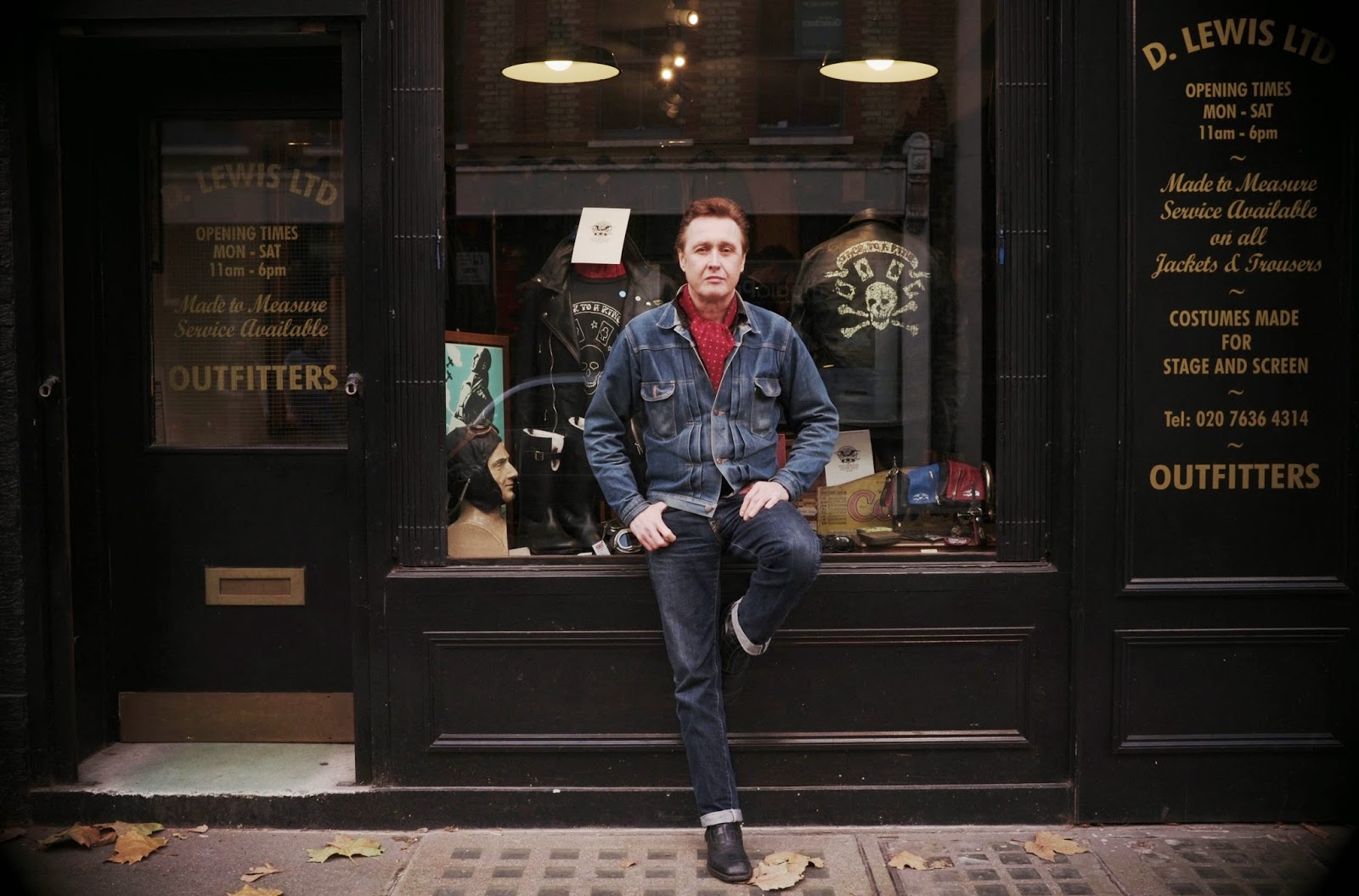
Derek Harris - owner of Lewis Leathers
Derek outside his London shop

The brand's endurance is down in no small part to the dedication of current owner, Derek Harris. I caught up with him recently to find out more about the firm. 

Rich Heritage

D Lewis Ltd begun life as a tailor's shop in London's Great Portland Street in 1892. By 1918, with the street now at the heart of the capital's “Motor Row”, it had diversified into making protective clothing for early motorists and flyers.

During World War 2 the company supplied the Royal Air Force with much needed kit.  With petrol rationing still in force after the war there was a boom in motorcycle ownership - something Lewis was able to capitalise on, selling off its surplus to newly de-mobbed riders, as well as producing modern riding garments.

In the late 1960s Lewis pioneered the use of coloured leather. It sponsored several bike teams including the legendary US 1964 ISDT team featuring Steve McQueen.

Steve McQueen in Lewis Leathers
Steve McQueen in Lewis Leathers... about as cool as it's physically possible to get...
At its peak in the 1970s Lewis Leathers had six shops across the UK, but by 1986 these had all closed.
The firm remained family run until 1981 and has had several owners over the years, with Derek taking up the reins in 2003.

A Cultural Education

Growing up immersed punk culture, Derek had a longstanding interest in Lewis Leathers as a punter. His awareness of motorcycle culture began from an early age.
“Lewis was a name I was aware of in the 1960s as a 7- or 8-year old and I clearly remember Rockers riding around on the council estate where I lived.” But it wasn't until 10 years later with the birth of punk, and inspired by the likes of The Clash and Jonny Thunders, that Lewis Leathers came back on his radar.

“That was an impressive thing to me and my friends, we looked upon those bands as being authentic as opposed to the likes of say, Queen and Elton John. The fact they were wearing clothes we could identify with like brothel creepers, Dr Martins and LL jackets was quite a striking for us at the time.”

But Lewis Leathers jackets were expensive and out of reach for a young guy even then. “It wasn't until the late 70's that I bought a second hand Lewis jacket (a Corsair.) Finally I'd got my hands on one! It was something that gave me a lot of pride to wear, as I guess it did most people who had them in those days.”

Lewis Leathers shop interior
A leather fans' wet dream...

Big In Japan

Derek was a key figure in the introduction of the brand to Japan in the 1990s - an event that, after the doldrums of the 1980s, was the catalyst for Lewis Leathers enjoying a rebirth and wider renaissance.

In 1991 he visited friends in Tokyo who ran a small company selling rock music based clothing - Mod suits from Carnaby Street, Teddy Boy shoes, t-shirts, bondage trousers etc. The Japanese had difficulty sourcing things from the UK, but that “Made in the UK” label was crucial - and one of the things they really needed were leather jackets.

Derek immediately made a beeline for Lewis Leathers because, to him, that was the brand with the right heritage. However, the jackets had changed a lot by the 90s. "If we were going to sell them they needed to look more like they did in the 1960s and 70s than they did in the 90s.”

Derek says that there was nothing wrong with the jackets of the time. But compared to vintage examples the patterns and detailing were not quite right.  So he approached the then owner Richard Lyon about producing a more classic looking range for Japanese buyers.

“He was interested so I set about buying vintage jackets. I lived on Portobello Road so I picked up things like the Lightning, Bronx & Dominator jackets and took them to an old guy in the East End, a chap called Max Bargroff - a great pattern maker.”

These patterns were then taken back to Lewis Leathers. In the meantime, helped by his fastidious research of Lewis Leathers history and ballooning collection of vintage motorcycle magazines catalogues and adverts, Derek set about the mammoth task of sourcing the correct lining, zippers and correct labels for the new brand. By Autumn 1992 the first full range featuring six jackets and some boots was up and running.

The range continued to expand steadily before enjoying a surge of interest in 1995 when another Japanese friend of Derek’s started the 59 Club Japan. (Lewis Leathers had a long association with the original British club.) 
Lewis Leathers - 59 Club
Father Bill - driving force behind the original 59 Club.
Many Japanese guys wanted the British motorcycle look and their interest brought it to the forefront. The predominant look for most guys over there was Amicaze -  American casual with American bikes, American jackets and the different look that went with California style.

“Suddenly people became aware of Lewis Leathers and its connection with motorcycle racing, with youth cultures like Rockers and punk, which was still very much appreciated at the time. They knew all about Malcolm McLaren and Vivienne Westwood's clothing and Dr. Martins etc, but they'd missed Lewis Leathers, so it kind of opened the door for us. We were there at the right time and the jackets started selling quite nicely.”

Rebirth of an Icon

And they continue to sell. Derek says the enduring appeal of a Lewis Leathers leather jacket is based on equal measures of heroism and rebellion, with men like RAF Test Pilot Sir Alex Henshaw and daredevil 1950’s bikers The Ton Up Boys all sporting the brand.

 “Not only were they (the Ton Up Boys) just riding fast - they had a kind of style that really captured the interest of the magazines & news papers. In the mid 50s The Daily Mirror carried a picture of a young guy on a Vincent with a headline that simply said "Suicide Club.” The story told of the dangers that these guys put themselves through.”

There’s a certain heroism and outlaw status attached to the leather jacket. The purportedly true story of bikers taking over the town of Hollister is a famous example - told in the 1951 film, The Wild One, depicting Marlon Brando’s character and his cohorts all wearing leather jackets as they ravaged McCarthy era small town America.

Lewis Leathers shop interior
Shop interior
The jacket that best typifies Lewis Leathers from this time, and one that Derek admits to being the most proud of, is The Bronx. Released in 1956 it had its roots in a jacket from the late 1920s. It was a jacket that, whilst its American name would have sounded exotic to English teenagers in 1956, was very functional. It had a big deep pocket on the front - a hangover from map pockets on flying jackets, but was tailored for modern bike riding.

A period advert for The Bronx
“The Bronx was a very iconic jacket for us. It moved Lewis Leathers from its pre-war image of a Dad's brand to a new era for the younger rider and the brand developed from there. Eventually, even though the shop was still called D Lewis Ltd, everybody called it Lewis Leathers.”

So, it’s not surprising the leather jacket became so popular with post-war British kids, gaining a wider appeal as a fashion item outside of the motorcycle community.

Lewis Leathers stands apart because it is quirkily British, says Derek. “Nowadays we seem to be a bit more exotic because to a certain extent we're still an unknown factor. We have a far wider range of styles than some of these big companies based abroad. That's part of our appeal.” 


Lewis Leathers - The Bronx


The Choice Is Yours

Another is very personal service. “We do a lot of custom manufacturing. People can come in and choose colours, stripes, different coloured sleeves, contrasting sleeve and body colours. All sorts of options are available to them."

Lewis Leathers roots in gents tailoring are alive and well today - made to measure jackets are a core part of the modern business.
One jacket is made by one machinist - a process that can take up to 20 weeks. Happily this is something Derek is not prepared to compromise on.

Devil's in the Detail

Talking to him this emerges as something of a theme - perhaps best exemplified by his obsessive quest for the correct vintage style zips, which are all made from brass and have been remodelled from vintage British zippers right down to the finest detail.

This same level of dedication goes in to the quality hides used by Lewis Leathers, with a minimum of 1.1mm thick Grade 1 hides being acceptable for the bike jackets.

"Size is important, the bigger hides mean getting bigger jackets out of them. We've been going for a hide that has technical detail - a water resistance to it, something that will keep you dry and warm on a motorcycle.”


Derek prefers cowhide, but customers can specify softer sheep hide. In recent years Lewis have been working with vegetable tanned sheep leather, obtained from a tannery in France.
Most Lewis Leathers jackets from the early 60s to the 70s we made in two versions, one in cow, one in sheep. Back then sheep was the cheaper option for those who wanted to wear them on the street or simply couldn't afford the hide version. 

Sheep leather has a different patina. Cow is quite, whereas sheep has more of a mottled surface. It breaks in a lot faster and many people prefer it than cow. It looks slightly older and creases quicker than a cow hide jacket. "It's not as durable either," says Derek. "If you're going to come off a bike I'd rather be in a cowhide jacket. But that's the customer's choice. These days vegetable tan hide is not a cheaper option because it's artisan made and now costs the same or sometimes more than cow hide.”

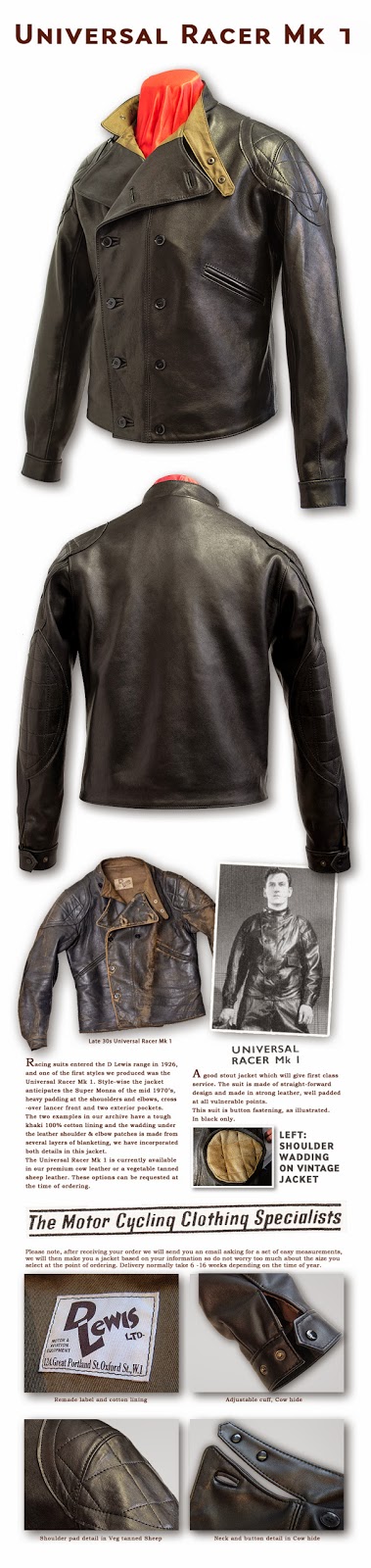
                                   Lewis Leathers - The MonzaLewis Leathers - The Universal Racer Mk 1

Heritage & Innovation

Derek has recently started working with Italian horse-hide, but as he says, “It's pretty new to us, we've only been producing it this season.”
There are several other new projects in the works, with Derek taking an increasingly longer look at the products the company made prior to the 1950s. A few of those pieces, like the 1936 pattern flying boot, the Lumber and Countryman jackets have already been introduced.

A project that Derek is particularly keen on is the developing of a jacket worn by Sir Alex Henshaw during his 1939 round-trip voyage from Gravesend to Capetown, setting a world record of four and half days in a single engine plane. 

Lewis Leathers - Sir Alex Henshaw
The legendary Sir Alex Henshaw.
“It's an iconic piece. These items are part of our deep history and heritage, so we're taking a look with a view reissuing them.”
Back in 2003 Derek worked with Kapital to introduce a small range of denim and plans are afoot to introduce two new styles this year, one a slim fit and one a classic 501 type fit. “We'll have our own little tweaks and detailing to put in. This time we're working with a very small manufacturer I found on my last trip to Japan. I'm very excited about it."

So am I, if the results of the collaboration are anything like the quality of Derek’s jackets then these jeans will be worth checking out.

Lewis Leathers - denim
Some of the original denim range.
Clearly Lewis Leathers is heavily influenced by its heritage, but this is not at the expense of innovation. It’s fantastic to see someone like Derek invest so much genuine passion and knowledge in to what he does - ultimately this means a better leather jacket for you the customer. Importantly it should also ensure that Lewis Leathers will be around for a long time to come.

At upwards of £600 a jacket you might have to lay off the life of wine, women and song for a while, but if you look after it a Lewis Leathers it will last you a lifetime, only getting better with age. 
As Derek says, “over time a leather jacket, like a pair of denim jeans, tells a story.” Indeed.

If you’re in London the shop is well with a visit or you can purchase online here.

(Many thanks to Derek for taking the time to give me the interview. If you want to see more pix check them out here.)

Tuesday, 25 February 2014

Flying High - Eastman Leather Clothing

Interview with ELC founder, Gary Eastman.


One of ELC's Elite Unit jackets - The "Hells Angels" 303rd Bombardment Group A2.
The A2 flight jacket is something of a style icon. Issued to American flyers from 1931, after WW2, as with many other items of military clothing, its stylish yet rugged utility meant that surplus stocks were rapidly adopted by civilians. The nostalgia factor has ensured that the A2's popularity has endured. A modified version is still in service with the US Air Force today.

Vintage examples are now as rare as hen's teeth, prohibitively expensive and too fragile to wear. So reproductions are your best bet. There are several companies out there to choose from, but one of the best is Eastman Leather Clothing (ELC).

I recently caught up with ELC's founder, Gary Eastman, who started the brand 30 years ago from a stable in Devon with only £300 in his pocket, a 1930’s Singer sewing machine and a passion for WW2 militaria.

He began making flight jackets owing to their scarcity. “They were essentially collectibles. It was hard to really wear them with conviction as one was afraid of damaging them. A jacket style like that looks best if you wear it the way it was intended - as a utility garment, in the rain or fixing your bike and not worrying. You just couldn't do that with an original - not if you valued its antiquity.”


Repro vs Original
Another reason was his dissatisfaction with the quality of reproductions available at the time - a key point that would go on to define ELC as it is known today. The reproduction companies that sprang up in the 1970’s weren’t getting it right. “They didn't really pay enough attention to detail, and the materials were modern versions of what was originally used. I felt it needed to be taken down a route where the essence of a true vintage garment was better represented - to do this would mean finding original sources of raw materials.”

This meant sourcing traditionally tanned Horsehide, instead of off-the-shelf commercial hides. He had to bin nylon or polyester linings in favour of cotton, and use the correct colour 100% wool plain-weave knit for the cuffs and waistband. On top of this there was finding the correct model zips, press studs and other fasteners. 


Meticulous detailing as standard - a 1940 Pattern RAF Flight Jacket
Achieving all this was not easy - especially back in 1984 when such information couldn't be found at the click of a mouse. That year, after completing a pattern cutting and grading course, Gary made his first five jackets. They sold within a week and he hasn’t stopped making them since.

Today ELC is one of the biggest suppliers of reproduction flight jackets, with an extensive range of A2’s. The line up is divided between the Original Maker / Elite Unit Jackets, painstakingly researched stitch for stitch recreations jackets made by the different US War Department contractors, and Eastman’s own jackets. Gary characterises the latter as jackets done in his own house style, “if we had been a war-time contractor, this is how our jackets would have looked.”


Eastman "House Style" A2 in Havana Brown Horsehide


Passion Over Profit

So exacting is the research, development and production of the Original Maker jackets that profit isn’t the top priority. "It really isn't - I will spend whatever it takes to get a detail right, because I know our customers will appreciate it. I want to see the end product come out like I’d like to find it in shop if I were the customer. I want to go, 'wow! I want one of those!’ ”

All of the jackets are bench-made locally in Devon, the hides hand-cut then sewn by a single machinist. For Gary this is crucial. "A tremendous amount of credibility is placed upon the fact these garments are made at our very own factory - the production of which is completely overseen and orchestrated by us. I think customers love to know these are proper bench-made products, by a company they can feel in-touch with because it is traditional, and not mass-produced. Heritage products like this have to carry honesty, because the customers are as passionate about owning them, as we are making them - it goes hand in glove.”

The fact Eastman supplies Buzz Rickson is indicative of the level of detailing that goes into these garments. The pair have been collaborating since 2003, something Gary is rightly proud of.

On top of all this, Eastman also offers a small range of British and German flight jackets, accessories and civilian jackets.


A Thunderbird Field - essentially a civilianised version of the earlier A1 that was popular with flight instructors of the time.


A New Direction

Devon didn't know what hit it....
This expansion led Gary to recently launch the sub-brand ELMC - Eastman Leather Motorcycle Club, which takes inspiration from the iconic the mid-20th century American West Coast motorcycle club culture.

Again, these jackets are bench-made in Devon to the same exacting standards using veg tanned horsehide, mostly custom produced for Eastman by tanneries in Italy.


ELMC Roadster in Walnut Brown
Also available is an extensive range of other apparel and accessories, including T-shirts, footwear and sweatshirts. All the fabric garments are produced exclusively for Eastman in Japan - “ the best place on earth to get true vintage-quality products produced. These are all made through the eminent John Lofgren workshops, to precise detail: body-size tube construction, specialist yarn cottons, all made on old vintage loop-wheel looms.”


Flying The Flag

The tan Californian (I'm talking about the jacket.) Beard optional.
It is exciting to see a British brand be daring enough to expand like this. Clearly, Eastman’s pedigree is in flight jackets, but given the production expertise and passion with which they are made ELMC is bound to meet with similar success. 

So how does Gary see Eastman as a whole evolving over the few years? He's charmingly relaxed about it. “I am happy with how it is - we have been busy from the first day we started, so I want to keep it like that. If the demand is there, we will follow it up as closely as we can. ELMC is a new pasture, so who knows where that will go - onwards and upwards is certainly the trend.”

Which jacket is he most proud of? Hands down, it's the ultra rare A1, only in service from 1927 to 1931. “The grandaddy of all American flight jackets.” In 30 years of collecting he has only seen three of them, and the one Gary managed to snag for himself was totally original. So Eastman was able to match every detail for the very first time. So much so that other manufacturers use the pictures on Eastman’s website for historical reference. 

As far a Gary is aware it's the only reproduction A1 that is 100% accurate.


ELC's finest moment? The reproduction of an ultra rare A1.
Now that’s dedication. If you’re looking for meticulously researched and produced flight jacket you can do no better than an Eastman. I speak from experience. I’ve had my own A2 for eight years now. It’s broken in beautifully and, unlike me, is only getting better with age. 
Gary says we shouldn’t be precious about wearing his jackets. “Wear it like it was intended - a utility garment. Wear it in the rain; down the pub; driving; walking the dog…falling over walking back from the pub. The more you wear it, the more it will become you.”

I don’t have a dog, but I can vouch for the rest.

If you’re interested do have a look at ELC here. More on Eastman Leather Motorcycle Club soon, but you can have a look at the range here.


(With thanks to Gary for taking the time to answer all my questions. All images courtesy of ELC.)

Wednesday, 18 December 2013

How To Avoid Gortex...

Restoring a Vintage Swedish Army Rucksack...

... Or at least pepping it up a bit.

1950's Swedish Army Rucksack
Not a stitch of technical fabric in sight.
The search had been on for a while for a decent vintage or reproduction rucksack or day sack. The Swedish outdoor brand Fjällräven make fantastic retro inspired, and very durable, trekking kit. However, their price point is rather high - at nearly 1,800 Swedish kronor (approx £200) for a 40 litre bag I decided to look elsewhere.

It's clear that Fjallraven have taken as their inspiration the original Swedish and British Army commando rucksacks from WW2.

1950's Swedish Army Rucksack1950's Swedish Army Rucksack

So I set about finding one. This example was £20. According to the seller the pack is post war. Metal framed and made from thick field grey canvas and heavy leather, 60 odd years on the rucksack was still in pretty good condition.

A few minor repairs have been done on the canvas and the leather was a little tired, but that's it.
The stitching was all in good condition, with no repairs needing doing.

I set about washing the canvas first. I scrubbed the lot with a hard brush in warm water. No soap. This supposedly expands the canvas fibres, and as they re dry they become even tighter - hence more water resistant.

As this was drying I turned to the leather, applying a liberal coat of Leder Gris leather grease to all of the harness and straps. Leder Gris is made of entirely natural ingredients, with none of the degrading chemicals you find in normal polishes like Kiwi. This helped to moisten the quite dry leather fixings after what presumably had been long years of storage.

1950's Swedish Army Rucksack
Despite years in storage the dry leather responded wonderfully to a working over with some leather grease.
I was in two minds as to whether it needed waxing. There are separate schools of thought here. The first says just wash the canvas - the wet fibres will expand and then shrink tighter with drying. To wax a vintage item will only push the dirt you could not wash out deeper in to the fabric, shortening its lifespan.

The second argues that a coat of wax will obviously increase the waterproofing - more important on something designed to spend its working life outdoors.
There was a district whiff of paraffin prior to the wash, so the pack had clearly been waxed previously.

Fjallraven Greenland Wax
You can try making your own with a mix of bees wax and paraffin, but I had some Fjallraven Greenland wax to hand anyway.

I applied a thin layer all over, but paid particular attention to the seams, bottom and lid - all points that get the most wear / exposure.

You simply warm the wax and rub it in to the canvas as evenly as possible. Once that's done the wax needs drying - I stole the wife's hairdryer and just worked over the pack panel by panel.

It should be good for quite a few Danish winter downpours now.

However you choose to treat your pack, if you're going to be out in inclement weather you'd use a dry bag inside the pack anyway.
When the pack next needs waterproofing, I might try making my own wax and applying it melted with a brush - this is supposed to give a much more even finish.

1950's Swedish Army Rucksack
Tool attachment loops. Not that I have an ice axe, but if I did these would be most useful.

1950's Swedish Army Rucksack
A simple top loading pack with heavy duty draw string closure.
To wear the pack is surprisingly comfortable, and at 40 litres, is perfect as a overnight or weekend bag. There are loops for a bed roll and an ice axe / entrenching tool, so it is definitely still functional in it's original role. I'm not sure I'd want to take it on a long trek though.

With minimal expense, time and effort you can easily bring one of these bags back to life. Why waste money on modern branded examples?

1950's Swedish Army Rucksack
Bed roll or sleeping mat straps .

If you're tempted they are still readily available from Ebay and various surplus stores.