Showing posts with label denim. Show all posts

Thursday, 3 July 2014

1952 British Army Denim Battledress Blouse

The DNA of the humble battledress blouse can clearly be seen in post-war casual and work jackets - most famously in civilian versions of the American "Ike" jacket.

British Army Denim Battledress


The blouse began life when, looking for a replacement for WW1 era Service Dress (SD) more suited to modern combat operations, the British War Department settled on Battledress in 1937.
Much shorter than its SD tunic predecessor, the BD blouse was originally worn over a collarless shirt and buttoned at the back to a pair of matching trousers.

British Army Denim Battledress


Issued on a large scale in 1939, this is the itchy heavy wool uniform that most British and Dominion troops set off to war with.

A Working Dress version was also made in selvedge denim - cut larger to be worn over the wool uniform for doing dirty jobs around barracks. (So you will need to size down.) However, as we all know, denim is ever practical and the material proved ideal for operations in hotter climates - it was widely issued, or "acquired" by troops fighting in the Mediterranean.

Made from green or brown selvedge selvedge denim (I'd guestimate the denim to be around the 11oz mark) these are robust little jackets.
With pleats front and rear they're quite roomy too. The buckled belt nips in the waist to give a quite boxy silhouette.

British Army Denim Battledress
Pleats.
The trousers are identical to their woollen cousins, obviously apart from the one line of selvedge visible on the strong felled out-seam.

With a high waist line hovering dangerously close to the nipples, they were clearly meant to give a silhouette that emphasised height - important when attempting to instil fear in the the hearts of advancing German infantry!

British Army Denim Battledress
Waist belt buckle detail.
In fact such large stocks of denim and wool battledress blouses were left behind by the British at Dunkirk they were recycled by the Germans and issued to U Boat crews. 

Various patterns of the wool blouse were made over the years, with the most alterations being made to the collar and button placket, but the denim versions always stuck closely to those first issued in 1937 - with a simple rise & fall collar clipped at the top, and the exposed buttons of the later 1940 "Austerity Pattern." The removal of the covered placket an economy measure that saved on cloth.

British Army Denim Battledress
Simple rise-and-fall collar clipped at the top.
These blouses were made to be used hard, so the bakelite buttons are held on by cleats - easy to remove for washing. I suspect soldiers back then had other things in their mind than developing fades on their denim!

The blouse you see here was made in 1952 by Denham. There were a myriad number of contractors over the years, all with small differences between them. (Sadly I could not find any information on Denham.)

Original War Department label.
As a combat uniform battledress was still worn in the Korean War, but fell in to disuse with the issue of Herringbone Twill uniforms poached from the Americans.

As our own cotton combat uniform came in to service there was no real need for denim or wool battledress and it ceased to be issued in 1961.

British Army Denim Battledress
Pocket detail with what look like bakelite disc buttons.
American uniform items have always been extremely popular, with companies like Buzz Rickson's offering top dollar recreations. They're fantastic I agree, but I'd argue that, although not as well known, British denim uniforms are just as stylish. To Nigel Cabourn's credit he did a version of the trousers for his SS14 collection.

Worn with jeans the blouses look great over a guernsey or a submariner jumper, or a work shirt in summer. Just the thing for cutting about town. (Or a clandestine meeting with your resistance contact to blow up a bridge!) 

Earlier examples are becoming scarce, but post war versions are still straightforward to find.

I found mine on Ebay, but it is worth checking surplus suppliers to see what they have. There are also various reproduction companies making copies for re-enactor types, though the denim is not selvedge.

I'd argue you're better off with an original.

Friday, 30 May 2014

Lewis Leathers - A British Icon

The term is an overused one, but Lewis Leathers – Britain's oldest manufacturer of motorcycle clothing – is a true a fashion icon. Few clothing companies can trace their heritage back to 1892.

Fewer still have played such a huge role in youth culture. The Beatles; The Sex Pistols; Lemmy; Lou Reed; the Ramones; The Libertines; Alex Turner from the Arctic Monkeys…they've all worn Lewis Leathers over the years.
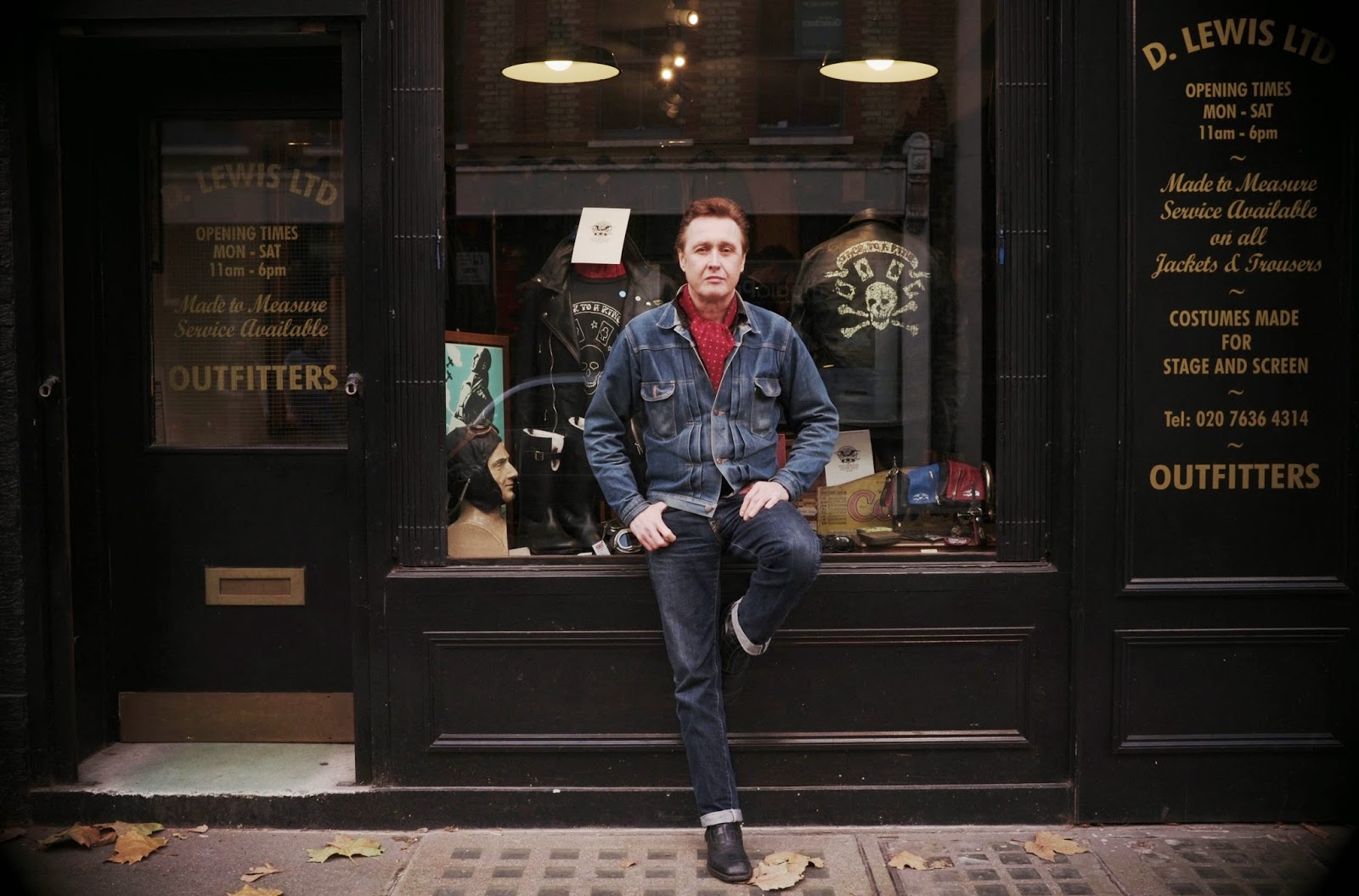
Derek Harris - owner of Lewis Leathers
Derek outside his London shop

The brand's endurance is down in no small part to the dedication of current owner, Derek Harris. I caught up with him recently to find out more about the firm. 

Rich Heritage

D Lewis Ltd begun life as a tailor's shop in London's Great Portland Street in 1892. By 1918, with the street now at the heart of the capital's “Motor Row”, it had diversified into making protective clothing for early motorists and flyers.

During World War 2 the company supplied the Royal Air Force with much needed kit.  With petrol rationing still in force after the war there was a boom in motorcycle ownership - something Lewis was able to capitalise on, selling off its surplus to newly de-mobbed riders, as well as producing modern riding garments.

In the late 1960s Lewis pioneered the use of coloured leather. It sponsored several bike teams including the legendary US 1964 ISDT team featuring Steve McQueen.

Steve McQueen in Lewis Leathers
Steve McQueen in Lewis Leathers... about as cool as it's physically possible to get...
At its peak in the 1970s Lewis Leathers had six shops across the UK, but by 1986 these had all closed.
The firm remained family run until 1981 and has had several owners over the years, with Derek taking up the reins in 2003.

A Cultural Education

Growing up immersed punk culture, Derek had a longstanding interest in Lewis Leathers as a punter. His awareness of motorcycle culture began from an early age.
“Lewis was a name I was aware of in the 1960s as a 7- or 8-year old and I clearly remember Rockers riding around on the council estate where I lived.” But it wasn't until 10 years later with the birth of punk, and inspired by the likes of The Clash and Jonny Thunders, that Lewis Leathers came back on his radar.

“That was an impressive thing to me and my friends, we looked upon those bands as being authentic as opposed to the likes of say, Queen and Elton John. The fact they were wearing clothes we could identify with like brothel creepers, Dr Martins and LL jackets was quite a striking for us at the time.”

But Lewis Leathers jackets were expensive and out of reach for a young guy even then. “It wasn't until the late 70's that I bought a second hand Lewis jacket (a Corsair.) Finally I'd got my hands on one! It was something that gave me a lot of pride to wear, as I guess it did most people who had them in those days.”

Lewis Leathers shop interior
A leather fans' wet dream...

Big In Japan

Derek was a key figure in the introduction of the brand to Japan in the 1990s - an event that, after the doldrums of the 1980s, was the catalyst for Lewis Leathers enjoying a rebirth and wider renaissance.

In 1991 he visited friends in Tokyo who ran a small company selling rock music based clothing - Mod suits from Carnaby Street, Teddy Boy shoes, t-shirts, bondage trousers etc. The Japanese had difficulty sourcing things from the UK, but that “Made in the UK” label was crucial - and one of the things they really needed were leather jackets.

Derek immediately made a beeline for Lewis Leathers because, to him, that was the brand with the right heritage. However, the jackets had changed a lot by the 90s. "If we were going to sell them they needed to look more like they did in the 1960s and 70s than they did in the 90s.”

Derek says that there was nothing wrong with the jackets of the time. But compared to vintage examples the patterns and detailing were not quite right.  So he approached the then owner Richard Lyon about producing a more classic looking range for Japanese buyers.

“He was interested so I set about buying vintage jackets. I lived on Portobello Road so I picked up things like the Lightning, Bronx & Dominator jackets and took them to an old guy in the East End, a chap called Max Bargroff - a great pattern maker.”

These patterns were then taken back to Lewis Leathers. In the meantime, helped by his fastidious research of Lewis Leathers history and ballooning collection of vintage motorcycle magazines catalogues and adverts, Derek set about the mammoth task of sourcing the correct lining, zippers and correct labels for the new brand. By Autumn 1992 the first full range featuring six jackets and some boots was up and running.

The range continued to expand steadily before enjoying a surge of interest in 1995 when another Japanese friend of Derek’s started the 59 Club Japan. (Lewis Leathers had a long association with the original British club.) 
Lewis Leathers - 59 Club
Father Bill - driving force behind the original 59 Club.
Many Japanese guys wanted the British motorcycle look and their interest brought it to the forefront. The predominant look for most guys over there was Amicaze -  American casual with American bikes, American jackets and the different look that went with California style.

“Suddenly people became aware of Lewis Leathers and its connection with motorcycle racing, with youth cultures like Rockers and punk, which was still very much appreciated at the time. They knew all about Malcolm McLaren and Vivienne Westwood's clothing and Dr. Martins etc, but they'd missed Lewis Leathers, so it kind of opened the door for us. We were there at the right time and the jackets started selling quite nicely.”

Rebirth of an Icon

And they continue to sell. Derek says the enduring appeal of a Lewis Leathers leather jacket is based on equal measures of heroism and rebellion, with men like RAF Test Pilot Sir Alex Henshaw and daredevil 1950’s bikers The Ton Up Boys all sporting the brand.

 “Not only were they (the Ton Up Boys) just riding fast - they had a kind of style that really captured the interest of the magazines & news papers. In the mid 50s The Daily Mirror carried a picture of a young guy on a Vincent with a headline that simply said "Suicide Club.” The story told of the dangers that these guys put themselves through.”

There’s a certain heroism and outlaw status attached to the leather jacket. The purportedly true story of bikers taking over the town of Hollister is a famous example - told in the 1951 film, The Wild One, depicting Marlon Brando’s character and his cohorts all wearing leather jackets as they ravaged McCarthy era small town America.

Lewis Leathers shop interior
Shop interior
The jacket that best typifies Lewis Leathers from this time, and one that Derek admits to being the most proud of, is The Bronx. Released in 1956 it had its roots in a jacket from the late 1920s. It was a jacket that, whilst its American name would have sounded exotic to English teenagers in 1956, was very functional. It had a big deep pocket on the front - a hangover from map pockets on flying jackets, but was tailored for modern bike riding.

A period advert for The Bronx
“The Bronx was a very iconic jacket for us. It moved Lewis Leathers from its pre-war image of a Dad's brand to a new era for the younger rider and the brand developed from there. Eventually, even though the shop was still called D Lewis Ltd, everybody called it Lewis Leathers.”

So, it’s not surprising the leather jacket became so popular with post-war British kids, gaining a wider appeal as a fashion item outside of the motorcycle community.

Lewis Leathers stands apart because it is quirkily British, says Derek. “Nowadays we seem to be a bit more exotic because to a certain extent we're still an unknown factor. We have a far wider range of styles than some of these big companies based abroad. That's part of our appeal.” 


Lewis Leathers - The Bronx


The Choice Is Yours

Another is very personal service. “We do a lot of custom manufacturing. People can come in and choose colours, stripes, different coloured sleeves, contrasting sleeve and body colours. All sorts of options are available to them."

Lewis Leathers roots in gents tailoring are alive and well today - made to measure jackets are a core part of the modern business.
One jacket is made by one machinist - a process that can take up to 20 weeks. Happily this is something Derek is not prepared to compromise on.

Devil's in the Detail

Talking to him this emerges as something of a theme - perhaps best exemplified by his obsessive quest for the correct vintage style zips, which are all made from brass and have been remodelled from vintage British zippers right down to the finest detail.

This same level of dedication goes in to the quality hides used by Lewis Leathers, with a minimum of 1.1mm thick Grade 1 hides being acceptable for the bike jackets.

"Size is important, the bigger hides mean getting bigger jackets out of them. We've been going for a hide that has technical detail - a water resistance to it, something that will keep you dry and warm on a motorcycle.”


Derek prefers cowhide, but customers can specify softer sheep hide. In recent years Lewis have been working with vegetable tanned sheep leather, obtained from a tannery in France.
Most Lewis Leathers jackets from the early 60s to the 70s we made in two versions, one in cow, one in sheep. Back then sheep was the cheaper option for those who wanted to wear them on the street or simply couldn't afford the hide version. 

Sheep leather has a different patina. Cow is quite, whereas sheep has more of a mottled surface. It breaks in a lot faster and many people prefer it than cow. It looks slightly older and creases quicker than a cow hide jacket. "It's not as durable either," says Derek. "If you're going to come off a bike I'd rather be in a cowhide jacket. But that's the customer's choice. These days vegetable tan hide is not a cheaper option because it's artisan made and now costs the same or sometimes more than cow hide.”

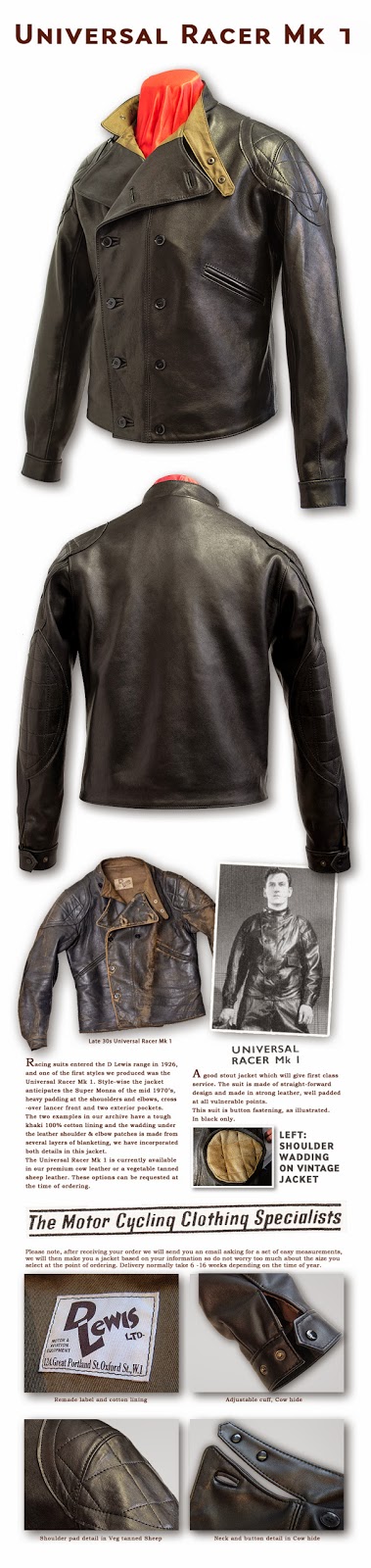
                                   Lewis Leathers - The MonzaLewis Leathers - The Universal Racer Mk 1

Heritage & Innovation

Derek has recently started working with Italian horse-hide, but as he says, “It's pretty new to us, we've only been producing it this season.”
There are several other new projects in the works, with Derek taking an increasingly longer look at the products the company made prior to the 1950s. A few of those pieces, like the 1936 pattern flying boot, the Lumber and Countryman jackets have already been introduced.

A project that Derek is particularly keen on is the developing of a jacket worn by Sir Alex Henshaw during his 1939 round-trip voyage from Gravesend to Capetown, setting a world record of four and half days in a single engine plane. 

Lewis Leathers - Sir Alex Henshaw
The legendary Sir Alex Henshaw.
“It's an iconic piece. These items are part of our deep history and heritage, so we're taking a look with a view reissuing them.”
Back in 2003 Derek worked with Kapital to introduce a small range of denim and plans are afoot to introduce two new styles this year, one a slim fit and one a classic 501 type fit. “We'll have our own little tweaks and detailing to put in. This time we're working with a very small manufacturer I found on my last trip to Japan. I'm very excited about it."

So am I, if the results of the collaboration are anything like the quality of Derek’s jackets then these jeans will be worth checking out.

Lewis Leathers - denim
Some of the original denim range.
Clearly Lewis Leathers is heavily influenced by its heritage, but this is not at the expense of innovation. It’s fantastic to see someone like Derek invest so much genuine passion and knowledge in to what he does - ultimately this means a better leather jacket for you the customer. Importantly it should also ensure that Lewis Leathers will be around for a long time to come.

At upwards of £600 a jacket you might have to lay off the life of wine, women and song for a while, but if you look after it a Lewis Leathers it will last you a lifetime, only getting better with age. 
As Derek says, “over time a leather jacket, like a pair of denim jeans, tells a story.” Indeed.

If you’re in London the shop is well with a visit or you can purchase online here.

(Many thanks to Derek for taking the time to give me the interview. If you want to see more pix check them out here.)

Friday, 28 March 2014

Shop Review - A Small Jeans Company

A Small Jeans Company
Carsten outside ASJC HQ.
Some of the more high end denim stores, complete with standard issue hipster scowling at you from behind a counter, can feel a little unwelcoming when you go in.

Not so Copenhagen's newest denim shop A Small Jeans Company (ASJC). Tempted by the offer of coffee and obligatory Danish pastries I met up with owner Carsten Frederiksen for an interview.

ASJC is a very personal project for Carsten. As its name suggests ASJC want to keep things, well, small. His background however is working in sales for large brands such as Tommy Hilfiger and Tiger of Sweden in the more formal tradition of gents' tailoring. As Carsten admits though,
"It makes no sense for a denim-head, but when working with formal wear I started realizing that clothes go way deeper. Suddenly I found myself much more drawn to denim. Most end-consumers know that tailoring, the combining of fabrics and fits, is a sort of science. The same counts for denim in general. But what really triggered it was longevity. In this case denim beats formal wear any day. Personally I prefer a mix of denim and formal wear. Add a leather jacket and I'm a happy guy"

A Small Jeans Company

Indigo, Craftsmanship, Stories

Talking to Carsten it's clear he applies formal tailoring's high standards to what he stocks at ASJC, yet this as much as his relaxed attitude informs what he wants to achieve with the shop,
"We have no ambition of becoming a big jeans company or getting rich and famous. We focus on providing good, long-lasting stuff for customers. We prefer products before branding. When I opened up I thought well known commercial brands were important. Luckily they are not. The end-consumer has become much more aware of what they're buying. Therefore we focus on production, country of origin, fabrics and brand DNA." 
 This means brands such as Tellason, Pace Jeans, Tanner Goods and Lewis Leathers take precedence over more commercial fodder. ASJC's motto is Indigo, Craftsmanship, Stories. The provenance and quality of a garment is more important than than the branding it carries - perhaps a surprising approach for a shop only a stones throw form Copenhagen's main shopping drag Stroget.


To his credit Carsten is not interested in compromising on the quality of what ASJC stocks,
"Quality denim is for me a solid and clean product in every detail. With this I mean what is the purpose of making a fantastic heavy ounce denim then putting in cheap buttons or compromising on pocket lining or rivets? In general I prefer American or Japanese raw denim made with a clean look. Tellason is a good example. Even if you are not into denim you can see that things have been thought heavily about."   
Starting any new business is hard and mistakes are easy to make. Despite the shop's central location traffic flow has been one of ASJC's biggest challenges,

"Copenhagen is a big city and knowledge (of us) is still small. We are growing every day and becoming more settled. Customers come back and that is a good thing!" 

Carsten is candid about the initial difficulty getting the mix of brands right, but argues the shop will benefit from it in the long run,
"A Small Jeans Company will only get better and more interesting for denim orientated guys."
A Small Jeans Company

A Small Passion

Despite these challenges, after working for the big boys A Small Jeans Company represents a refreshing change, with Carsten's motivation stemming from doing something he genuinely loves,
"I'm doing this now and hopefully for the rest of my life. I have had good jobs and been happy about them but this career choice is by far the best decision made."
So what brand is he most proud of? Carsten acts as an agent for the Swedish brand Pace Jeans, so they're perhaps not a surprising choice. However, I get the sense he means it,
"I love the way their denim are ages and they don't compromise on quality. The philosophy of keeping pace and moving on is fantastic. On a bad day I would prefer a less visible stitching on back pockets. But that's how it is with visual branding I guess. At the moment the PX-04 from Pace is keeping my legs warm."
ASJC - Pace Jeans

With regard to breaking his own jeans in Carsten doesn't have any special routines, preferring to simply break his jeans in from dry,
"for me it's all about getting them on and when they don't work anymore it's time for a change. For customers I recommend they have patience and simply just wear them whatever they are doing. I think it is up to the single person if they want to rub their dirty hands in them, work in the garage or garden - or even wash them (always inside out) because they have an office job. I think the journey starts when they buy a pair of dry jeans and they will find out what works for them."
Carsten brings a life-long passion for clothing to ASJC, and it seems to be working for him,
"My motivation definetly comes from doing what I really love and am passionate about. I am doing this now and hopefully for the rest of my life. I have had good jobs and been happy about them, but this career choice is by far the best decision made. It is hard, but I love riding my bike to the store in the mornings and developing the business. Furthermore Copenhagen Center needs this kind of shop. Period!"
A Small Jeans Company

Copenhagen shops are not known for friendly customer service, so this attitude is good news for Danish denim-heads. As Carsten says,
"I don’t expect for people to be blown away but if they don’t find it relaxed and feel welcome for shopping or hanging out - then I am doing something wrong. "
There's normally always a pot of coffee on and regular beer evenings, so if you're after some new denim why not pop for a chat?
If you can't make it the web-shop will be up and running very soon. Check out ASJC here.


Tuesday, 11 February 2014

Selvedge & Sustainability

Denim is arguably today's most ubiquitous fabric, with examples in virtually every wardrobe. However, it started life as workwear - the rugged shuttle loomed indigo dyed cotton twill having been worn in Europe since the 1700's.
Selvedge edge on a pair of Pike Brothers jeans
Normally the hallmark of decent denim - the selvedge edge on the outer seam of a pair of jeans.
This tough fabric unsurprisingly found popularity in the rough milieu of 19th century America. Famously in 1873 Levi Strauss began production of his riveted overalls, with the first 501 jeans (waist overalls) appearing in 1890.

After WWII denim made the leap from work to casual wear, experiencing a boom in popularity.

Unable to keep pace with demand, by the early 1980's the Big Three - Levi's, Lee & Wrangler - had all switched to wide loom production, selling their old shuttle looms for scrap. (Not sending them to Japan as denim folklore has it.)

Today almost all denim is produced this way -  on wide looms, capable of churning out enough cheap fabric to keep pace with demand, but giving an end result of vastly inferior quality.

The rise in the popularity of selvedge denim - driven by early Japanese brands like Evisu in the 90's - has gone some way to countering this. Today there are a plethora of selvedge denim brands out there, from Japan to America & Europe.

The American brands caught on rather late. In fact Levi's unleashed a raft of lawsuits in the 90's preventing Japanese labels from using their branding and arcuate.
As a company Levis realised their mistake - with their jeans filling bargain bins at $30 a pop customers must have got wind that quality and craftsmanship had somewhat fallen off.
This is where Levi's Vintage Clothing stepped in to redress the balance. Luckily they had kept a few of the old shuttle looms in a dusty corner of Cone Mills and today produce some of the nicest selvedge denim out there. (And being Levi's so they should.)

Lee and Wrangler also caught on and still produce high quality selvedge denim under Lee 101 & Wrangler Bluebell.

Hardly a month goes buy without a new brand launching. And the quality does vary. To say that all selvedge denim is good is misleading, just as not all non selvedge is bad. Just look at brands like Old Town as a case for the latter.

One of the most appealing aspects of decently made selvedge denim is that it will last for years. In short it's more sustainable - you don't have to repeatedly spend money on inferior jeans, putting yet more burden on cotton production, and exploiting low paid workers in some far flung sweat-shop churning out umpteen garments a day.

If you buy raw (which you should) you're doing the environment a favour too - some poor bloke then does not have to blast your jeans with a load of chemicals just to pre distress them. When did people get so lazy that they couldn't be bothered to break in their own clothing?


An indicator of selvedge denim's current popularity is that the big brands are getting in on the act. At the fashion trade show Bread & Butter in Berlin last month, several commercial labels were launching lines of selvedge denim for Spring / Summer '14. Whether the lines will last more than a few seasons I'm not sure.

Nudie have just launched a selvedge denim line for kids. As a brand they make a point of stressing sustainability and, to Nudie's immense credit, are very open about their production processes.

So the launch of a selvedge range for ankle biters came as something of a surprise.

I am reliably informed that children grow. There's no stopping them. Perhaps I'm being cynical, but all that beautiful selvedge denim, bought by wealthy parents with more money than sense, will probably get binned once the little blighters have out grown it. It might end up in a charity shop, or the most positive outcome - be passed down to a younger sibling. At 900DKK for a pair I hope the latter prevails.
To be fair to Nudie they have designed the jeans with waist tabs so the things can be let in and out as offspring grow.

Is that sustainable? In fact, with the explosion in popularity of selvedge denim as a whole I wonder if the mills still using old narrow looms can keep pace. After all, is that not why manufacturers switched to wide loom production in the first place?

I'm all for selvedge denim, in fact I love the stuff and would like to see more people wear it. Put simply it's higher quality and better for our planet. You don't need loads of pairs cluttering your wardrobe, just rotate a couple of jeans and they will last years.

Perhaps I'm generalising, but most folk tend to buy too many clothes and are nowhere near discerning enough in their purchases.
Selvedge denim may have a higher price point, but you'll buy less of it and be buying ethically - a principle it would do no harm to extend across your entire wardrobe.

For a brand like Nudie, the launch of children's selvedge denim line rather goes against this idea and against the sustainable principles they profess.

Then again in days of yore kids always wore selvedge denim and I'm sure ageing 30 something denim-heads will be tickled pink to clothe their spawn in selvedge denim.
Looking at the positives it might instil a love of the fabric in to a whole new generation and encourage parents to recycle their kids clothing, but this relies on said parents doing the right thing.

As an industry I suspect this might be the wrong way forward. I hope I'm wrong.

Have a look at Nudie's new kids range here.

Wednesday, 11 December 2013

Old Town Clothing.

A Brilliant Little World Of Its Own - Interview with Will Brown

The Norfolk based brand Old Town Clothing have been long standing favourite of mine - the Navy twill suit I bought from them years ago is still in regular service.

On behalf of Denim Hunters* I recently caught up with Old Town's co-founder, Will Brown, for an interview. (Read an edited version there and see Matt Hind's fantastic Piccadilly Pleasures images used for the article.)
The Marshalsea in Khaki canvas. This slightly fitted 4 button jacket has a district 1890's feel to it.
(I've been wearing a Navy version for 7 years now.)
High Rise trousers in the same canvas. They have a pleasingly high waist and wide leg.
 Originally based in London, Will has been making clothes for over 30 years. 
Old Town got its start in the mid 1980’s, “I opened a shop in Shoreditch in 1980 when there was little other than the last remnants of the furniture making industry in the area. It wasn’t very successful, but I was supplying a few garments to a boutique called ‘Demob’ in Soho. I was given the run of a spin-off shop, then called ‘Demobilization’ and by rearranging some of the nice fabricated letters on the facia it became ‘Old Town’.”
At first Norfolk might seem like an odd change of location. But it is consistent with Old Town’s desire to plough their own furrow. Indeed, the name “Tin House” was inspired by a local property they restored. 
Will was frank about the reasons for moving there, “My partner Miss Willey and I were living on a pretty grim estate in South London, but we found an old caravan on a bizarre plot in north Norfolk. We became attached to the area and found a shop with a flat in a 17th century street in Norwich. So, it seemed a good swap for Kennington. We opened Old Town so long ago the word ‘vintage’ hadn’t been invented (except when referring to wine or cars.)
The Marshalsea again - in Tin  House striped "Pantry Denim."
All patterns are modern in that they were designed by Will, but have a strict aesthetic firmly rooted in early 20th century utility clothing. 
Discussing what informs Tin House designs he said simply, “Historical imagery, costume and design reference. How to get the essence of a style with the least strokes? That’s what interests me most.”
 Old Town have developed a loyal following over the last few years. This rigorous aesthetic is part of their appeal. In the ever changing fashion world Old Town offer a simple continuity. 
Work wear is becoming increasingly popular, with many brands claiming to produce “heritage" or “authentic” items - something that Old Town stand against, “We never intended Old Town to be either of these. I don’t know at what stage designing and making something stopped being quite sufficient. 
The Short DB Jacket in 12oz Denim
It does rather feel that things have to have some sort of provenance today, however spurious. It’s quite a bloke-ish thing about spec and authenticity. I think that Old Town is more in the tradition of the early boutiques from the sixties and seventies like ‘Biba’ and ‘Let it Rock’ which were brilliant little worlds of their own.”
Old Town prefer to focus on quality and craftsmanship - all garments are hand made to order in and around the small village of Holt. With an average of 70 garments produced a week, the work is done by both Will himself and local artisans. Quality clothes take time. There is no web shop. You make your selection on a printed order form and post it off to Miss Willey. Turn around time for a garment is 4 to 6 weeks.
Orfords - a pattern of rugged seafaring jean much favoured on the Suffolk coast between the wars.
As Will says, “That’s how long it takes. Now just say that we were on a TV show like Challenge Anneka (remember that?) I dare say we could have a pair of trousers cut, sewn, buttonholed, buttoned, laundered, pressed and packed within a few hours. In practice trousers are cut as a group, the sewing ladies take their work on a weekly basis, the laundry similarly and so on. You can see how the days add up.
Also, I suppose customers do warm to the notion of the service and the necessary wait.”
All of Old Town’s material is UK sourced too. With so many labels looking for cheaper options abroad it is fantastic to see a brand do this. 
However, asked what Old Town look for when choosing fabric Will was quite direct, “Availability. We have been very fortunate with woollen cloths as they are woven in Britain and the minimum quantities are small (200 metres or so).
Cottons are tricky, even good old navy or khaki 3111 cotton drills aren’t that easy; we have to have the khaki dyed.
I would love to find interesting and obscure denims such as the old fashioned ‘salt and pepper’ effect that one used to see on warehouse coats. We would be laughed off trade stands at fabric fairs with the rather modest quantities that we could commit to. If anyone knows of interesting denims sold in less than a shipping containers worth I would love to know.”
A small range of ladies clothing also includes these, the no.5's - here in 12oz denim
Will may have very set ideas on what Old Town are, but not at the expense of the brand developing, “I hope it will continue to evolve, my instinct is towards a more modernist feel but I don’t know if customers would like it or not so I try to slip a bit in here and there.
What I’d really like to do is get off the buttonhole machine and have time to experiment, design clothes… in fact, just the nice bits but who wouldn’t?”
 Given that “a more modernist feel” probably equates to post 1930 die hard fans need not worry. Refreshingly un-fussed by the vagaries of fashion, Old Town simply focus on doing what they love. There is no empty marketing rhetoric here. Such integrity is sadly a rare thing these days.
Old Town is indeed a brilliant little world of its own, and whilst it’s clear that any brand has to evolve to survive, one hopes that Old Town keep doing what they do best - minimal yet beautiful clothes made by people with a profound love of what they do. If only more people thought this way. I urge you to check out www.old-town.co.uk.
*Unsurprisingly DHs preoccupation is with all things selvedge denim related. It is worth stressing that selvedge does not necessarily equal quality. By the same token not all non selvedge denim is bad.