Wednesday, 9 July 2014

Bristol Via Jakarta - NoKipple & The Elhaus Panna Shirt

Social media can be a wonderful thing, enabling us to discover brands that we otherwise would not have been exposed to. It's thanks to NoKipple pinging me on Twitter that I discovered Elhaus.

Based in Bristol NoKipple are very selective as to who they stock, specialising in high end denim and related clothing that is near impossible to find otherwise in the UK - but Elhaus have made the cut.

Elhaus Panna Shirt


Launched in 2010 the Jakarta located labels' philosophy is to take Indonesia's strong, traditional design history and combine it with modern cuts and experimental materials.

Indonesia has an up and coming clothing design and manufacturing scenes with brands such as Elhaus and OldBlue Co. at the forefront.

As NoKipple argue,
"We love Elhaus because they have no fear, they are more than willing to work on products that most smaller labels would deem as too risky or too costly, they love a challenge just as much as we have enjoyed working with them on a challenge."
A point amply demonstrated by the hand-woven jeans NoKipple & Elhaus collaborated on last year. (I know, I came slightly late to the party. The Denim HQ article on these awesome jeans, written by NoKipple's Gav, aka Megatron, is quite thought provoking.)

Elhaus NoKipple Jeans


But we're here to talk about the shirt. The material is light 5oz cotton, with a beautiful blue and white diamond Batik inspired pattern (a traditional technique of manual resist-dying - blocking the dye with wax to create the pattern.)
Elhaus Panna Shirt

The detailing is spot on - single needle stitching throughout, mother-of-pearl buttons, a split yoke, pointed collars, rounded hems and cuffs. 
I particularly like the side seam guessets and the stitching at the bottom of the placket - very period touches. The cut is slightly fitted but still quite classic in length.

All of these elements combine to create a classic American style work shirt, but with traditional Indonesian flourishes.


Elhaus Panna Shirt


In short it looks fantastic and, though long-sleeve, is lightweight enough to work perfectly for summer.

Tempted? The shirt is available only from NoKipple. Denim-heads amongst you should definitely check out the hand woven 21oz left hand twill jeans too. You don't normally see such attention to detail and commercially difficult artisan techniques used outside of Japan.

But that's rather the point. The selvedge denim industry is perhaps wrongly obsessed with branding and provenance. In an increasingly crowded market it can be hard for new brands to make headway, particularly those perceived to be from the wrong countries.

When did simply making something well become not sufficient?


Elhaus Panna Shirt

Indonesian brands like  Elhaus deserve recognition and wider popularity for what they're trying to do. I'm excited to see what NoKipple will get in from them next. Elhaus are definitely a brand to watch.

(Pix courtesy of NoKipple.)

Thursday, 3 July 2014

1952 British Army Denim Battledress Blouse

The DNA of the humble battledress blouse can clearly be seen in post-war casual and work jackets - most famously in civilian versions of the American "Ike" jacket.

British Army Denim Battledress


The blouse began life when, looking for a replacement for WW1 era Service Dress (SD) more suited to modern combat operations, the British War Department settled on Battledress in 1937.
Much shorter than its SD tunic predecessor, the BD blouse was originally worn over a collarless shirt and buttoned at the back to a pair of matching trousers.

British Army Denim Battledress


Issued on a large scale in 1939, this is the itchy heavy wool uniform that most British and Dominion troops set off to war with.

A Working Dress version was also made in selvedge denim - cut larger to be worn over the wool uniform for doing dirty jobs around barracks. (So you will need to size down.) However, as we all know, denim is ever practical and the material proved ideal for operations in hotter climates - it was widely issued, or "acquired" by troops fighting in the Mediterranean.

Made from green or brown selvedge selvedge denim (I'd guestimate the denim to be around the 11oz mark) these are robust little jackets.
With pleats front and rear they're quite roomy too. The buckled belt nips in the waist to give a quite boxy silhouette.

British Army Denim Battledress
Pleats.
The trousers are identical to their woollen cousins, obviously apart from the one line of selvedge visible on the strong felled out-seam.

With a high waist line hovering dangerously close to the nipples, they were clearly meant to give a silhouette that emphasised height - important when attempting to instil fear in the the hearts of advancing German infantry!

British Army Denim Battledress
Waist belt buckle detail.
In fact such large stocks of denim and wool battledress blouses were left behind by the British at Dunkirk they were recycled by the Germans and issued to U Boat crews. 

Various patterns of the wool blouse were made over the years, with the most alterations being made to the collar and button placket, but the denim versions always stuck closely to those first issued in 1937 - with a simple rise & fall collar clipped at the top, and the exposed buttons of the later 1940 "Austerity Pattern." The removal of the covered placket an economy measure that saved on cloth.

British Army Denim Battledress
Simple rise-and-fall collar clipped at the top.
These blouses were made to be used hard, so the bakelite buttons are held on by cleats - easy to remove for washing. I suspect soldiers back then had other things in their mind than developing fades on their denim!

The blouse you see here was made in 1952 by Denham. There were a myriad number of contractors over the years, all with small differences between them. (Sadly I could not find any information on Denham.)

Original War Department label.
As a combat uniform battledress was still worn in the Korean War, but fell in to disuse with the issue of Herringbone Twill uniforms poached from the Americans.

As our own cotton combat uniform came in to service there was no real need for denim or wool battledress and it ceased to be issued in 1961.

British Army Denim Battledress
Pocket detail with what look like bakelite disc buttons.
American uniform items have always been extremely popular, with companies like Buzz Rickson's offering top dollar recreations. They're fantastic I agree, but I'd argue that, although not as well known, British denim uniforms are just as stylish. To Nigel Cabourn's credit he did a version of the trousers for his SS14 collection.

Worn with jeans the blouses look great over a guernsey or a submariner jumper, or a work shirt in summer. Just the thing for cutting about town. (Or a clandestine meeting with your resistance contact to blow up a bridge!) 

Earlier examples are becoming scarce, but post war versions are still straightforward to find.

I found mine on Ebay, but it is worth checking surplus suppliers to see what they have. There are also various reproduction companies making copies for re-enactor types, though the denim is not selvedge.

I'd argue you're better off with an original.

Wednesday, 11 June 2014

A New Classic - Victorinox Swiss Army Infantry Chronograph


I've been after a new watch for a while, however decent time pieces can be a trifle pricy. So, the idea was put off as none essential and I soldiered on with my slightly embarrassing Sekonda.

Step in my dearly beloved wife. I hit the ripe old age of 38 last week - not a milestone I particularly wanted to celebrate. The Mrs, Hanna, lives in Copenhagen and I'm stuck in London for the forceable future. On the day I grumpily went in to the office as normal and thought no more of it. 

Well, my other half flew in last Wednesday and, after the obligatory shower of kisses, started to make vague hints about some sort of belated birthday surprise. In short this is how I found myself in the Victorinox flag ship store in Bond Street the following morning.


Victorinox Infantry Chronograph


Being Swedish, my beloved is a terribly efficient sort and had done extensive research it to the best available watches for a budget of under £500. Victorinox came up as the best answer, offering precision made Swiss chronographs at pretty respectable prices.

The range that caught her attention was Maverick - quite chunky contemporary time pieces with a large face. They look fantastic but as I have the wrists of a 16 year old girl they didn't quite work for me.


Victorinox Infantry Chronograph

Perhaps predictably I was immediately taken with the Infantry Chronograph range - as the name suggests the pieces are inspired by WWII era military watches. (As a cavalryman I'll ignore the fact they've named it after the infantry..)

Quite small by modern standards the watches sport a Ø 40 mm face and are outfitted with a Ronda 5030-D quartz movement. 
It displays three counters on the dial, as well as traditional pushbuttons to the right of the case middle on each side of the protected crown.


Victorinox Infantry Chronograph

The chronograph functions allow for 1/10th of a second precision timing and a small second and 30-minute counter.
Available in series of finishes I opted for the white face with a tan leather strap. If you're clumsy like me the tough scratch resistant sapphire crystal glass and stainless steel casing will see you right for years. 

The movement is not automatic, so you'll have to change the battery as needed but that's it.

For the money, £450, this is a quality Swiss watch that will last a lifetime.

Check out the range here.

Thursday, 5 June 2014

Buzz Rickson 1942 HBT Trousers

Summer is here.. even in England. A good thing,  however my trusty 19oz Pike Brothers jeans are getting a my legs a little too toasty. I do have lighter denim, but to give me a break from indigo I began looking for something different.

Buzz Rickson's Herringbone Twill 1942 Trousers


Herringbone Twill (HBT) is just as rugged as denim. So much so that the material was widely used by WW2 era militaries for their uniforms.

Introduced by the Americans in 1941 to replace denim working dress, US HBT uniforms are still widely reproduced - today the best by far are the stitch-for-stitch recreations offered by Buzz Rickson's. 


Buzz Rickson's Herringbone Twill 1942 TrousersBuzz Rickson's Herringbone Twill 1942 Trousers

So, for me, they were the natural place to start for an alternative to denim. Buzz Rickson's produce HBT trousers in several different patterns. I opted for the US Army 1942 version.

Made from high quality, military spec HBT, Rickson's argue that they feel and wear like a wartime original.


Buzz Rickson's HBT 1942 Trousers - coin pocket

Buzz Rickson's don't appear to have the '42 pattern on their site any more. However, they now do a '41 US Marine Corps (USMC) version.

The '42 Army pattern differs in that obviously they don't sport the USMC logo on the back pocket, have army buttons and a natural white twill lined waist band. Rather than utilitarian patch pockets they sport smarter sash pockets - including a coin pocket.

Buzz Rickson's HBT 1942 Trousers


So they don't feel too military - useful if you don't want to look like you're about single-handedly re-take Guadalcanal.

Confusingly these trousers, in cut and detailing, are exactly like the first 1941 pattern that gradually replaced pre-war denim fatigues, so I'm not sure why they're billed by Rickson's as 1942.

There were several shades of Olive Drab (OD) used over the years, and these are in the early war lighter sage green shade.

Buzz Rickson's Herringbone Twill 1942 Trousers


In any case, several patterns were worn widely until the end of the war - soldiers just sported what they were issued by the QM. So, unless you're a geeky re-enactor and get het up about such things, you need not worry.

As with several other items of military clothing their rugged utility, mixed with a pinch of nostalgia, give them an enduring stylishness that transcends the garment's original function as a working uniform. Simply put, for chaps seeking an excellently made vintage inspired pair of trousers, these are for you.

I found mine from Burg & Schild in Berlin, one of the city's best shops for quality denim and heritage menswear - and they still have a few pairs left. I urge you to go and visit these guys if you're in town, however if you can't make it the trousers are available online here.

(With thanks to Thomas at Burg & Schild for all the help. Pix ©Burg & Schild.)

Friday, 30 May 2014

Lewis Leathers - A British Icon

The term is an overused one, but Lewis Leathers – Britain's oldest manufacturer of motorcycle clothing – is a true a fashion icon. Few clothing companies can trace their heritage back to 1892.

Fewer still have played such a huge role in youth culture. The Beatles; The Sex Pistols; Lemmy; Lou Reed; the Ramones; The Libertines; Alex Turner from the Arctic Monkeys…they've all worn Lewis Leathers over the years.
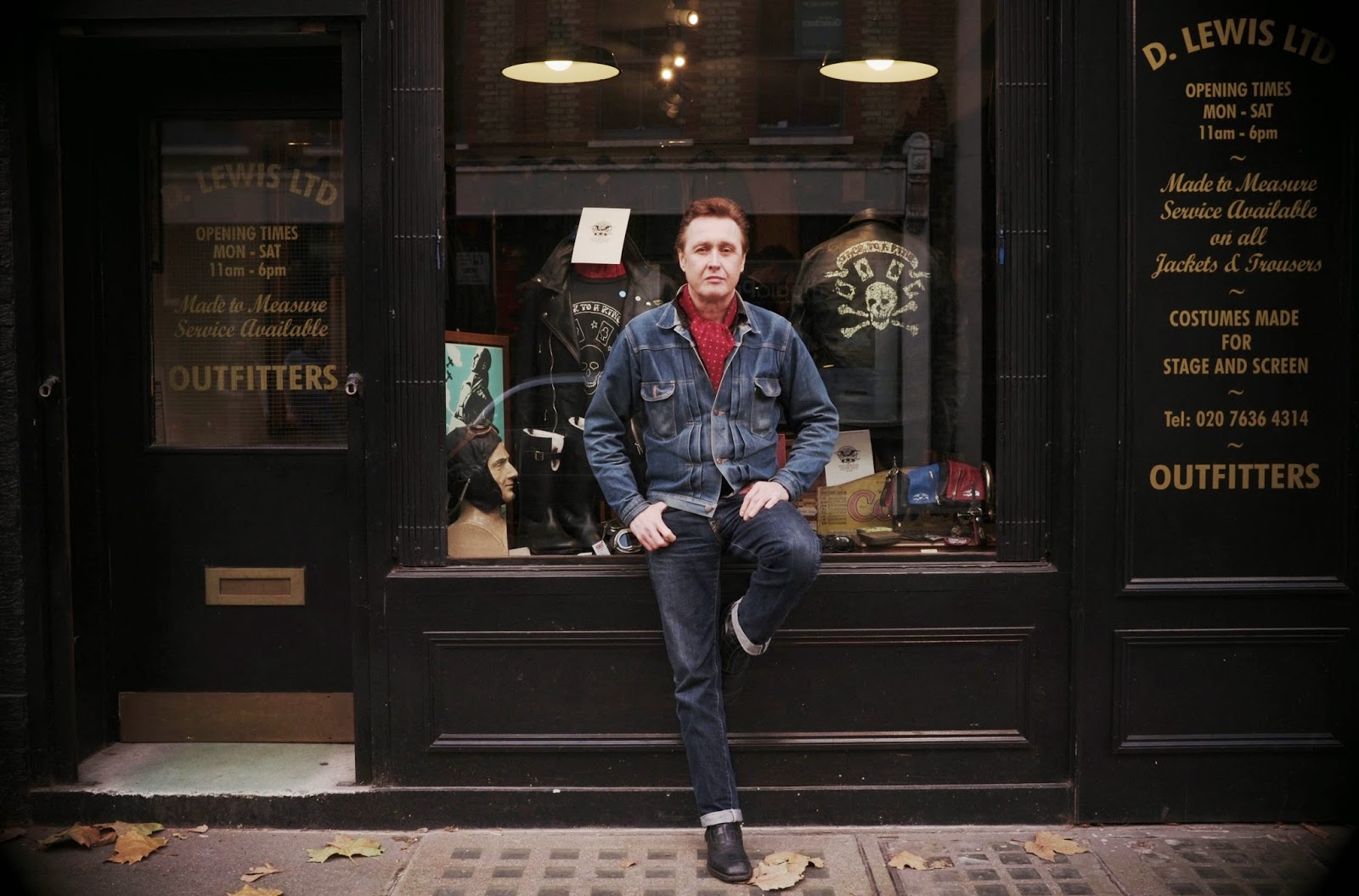
Derek Harris - owner of Lewis Leathers
Derek outside his London shop

The brand's endurance is down in no small part to the dedication of current owner, Derek Harris. I caught up with him recently to find out more about the firm. 

Rich Heritage

D Lewis Ltd begun life as a tailor's shop in London's Great Portland Street in 1892. By 1918, with the street now at the heart of the capital's “Motor Row”, it had diversified into making protective clothing for early motorists and flyers.

During World War 2 the company supplied the Royal Air Force with much needed kit.  With petrol rationing still in force after the war there was a boom in motorcycle ownership - something Lewis was able to capitalise on, selling off its surplus to newly de-mobbed riders, as well as producing modern riding garments.

In the late 1960s Lewis pioneered the use of coloured leather. It sponsored several bike teams including the legendary US 1964 ISDT team featuring Steve McQueen.

Steve McQueen in Lewis Leathers
Steve McQueen in Lewis Leathers... about as cool as it's physically possible to get...
At its peak in the 1970s Lewis Leathers had six shops across the UK, but by 1986 these had all closed.
The firm remained family run until 1981 and has had several owners over the years, with Derek taking up the reins in 2003.

A Cultural Education

Growing up immersed punk culture, Derek had a longstanding interest in Lewis Leathers as a punter. His awareness of motorcycle culture began from an early age.
“Lewis was a name I was aware of in the 1960s as a 7- or 8-year old and I clearly remember Rockers riding around on the council estate where I lived.” But it wasn't until 10 years later with the birth of punk, and inspired by the likes of The Clash and Jonny Thunders, that Lewis Leathers came back on his radar.

“That was an impressive thing to me and my friends, we looked upon those bands as being authentic as opposed to the likes of say, Queen and Elton John. The fact they were wearing clothes we could identify with like brothel creepers, Dr Martins and LL jackets was quite a striking for us at the time.”

But Lewis Leathers jackets were expensive and out of reach for a young guy even then. “It wasn't until the late 70's that I bought a second hand Lewis jacket (a Corsair.) Finally I'd got my hands on one! It was something that gave me a lot of pride to wear, as I guess it did most people who had them in those days.”

Lewis Leathers shop interior
A leather fans' wet dream...

Big In Japan

Derek was a key figure in the introduction of the brand to Japan in the 1990s - an event that, after the doldrums of the 1980s, was the catalyst for Lewis Leathers enjoying a rebirth and wider renaissance.

In 1991 he visited friends in Tokyo who ran a small company selling rock music based clothing - Mod suits from Carnaby Street, Teddy Boy shoes, t-shirts, bondage trousers etc. The Japanese had difficulty sourcing things from the UK, but that “Made in the UK” label was crucial - and one of the things they really needed were leather jackets.

Derek immediately made a beeline for Lewis Leathers because, to him, that was the brand with the right heritage. However, the jackets had changed a lot by the 90s. "If we were going to sell them they needed to look more like they did in the 1960s and 70s than they did in the 90s.”

Derek says that there was nothing wrong with the jackets of the time. But compared to vintage examples the patterns and detailing were not quite right.  So he approached the then owner Richard Lyon about producing a more classic looking range for Japanese buyers.

“He was interested so I set about buying vintage jackets. I lived on Portobello Road so I picked up things like the Lightning, Bronx & Dominator jackets and took them to an old guy in the East End, a chap called Max Bargroff - a great pattern maker.”

These patterns were then taken back to Lewis Leathers. In the meantime, helped by his fastidious research of Lewis Leathers history and ballooning collection of vintage motorcycle magazines catalogues and adverts, Derek set about the mammoth task of sourcing the correct lining, zippers and correct labels for the new brand. By Autumn 1992 the first full range featuring six jackets and some boots was up and running.

The range continued to expand steadily before enjoying a surge of interest in 1995 when another Japanese friend of Derek’s started the 59 Club Japan. (Lewis Leathers had a long association with the original British club.) 
Lewis Leathers - 59 Club
Father Bill - driving force behind the original 59 Club.
Many Japanese guys wanted the British motorcycle look and their interest brought it to the forefront. The predominant look for most guys over there was Amicaze -  American casual with American bikes, American jackets and the different look that went with California style.

“Suddenly people became aware of Lewis Leathers and its connection with motorcycle racing, with youth cultures like Rockers and punk, which was still very much appreciated at the time. They knew all about Malcolm McLaren and Vivienne Westwood's clothing and Dr. Martins etc, but they'd missed Lewis Leathers, so it kind of opened the door for us. We were there at the right time and the jackets started selling quite nicely.”

Rebirth of an Icon

And they continue to sell. Derek says the enduring appeal of a Lewis Leathers leather jacket is based on equal measures of heroism and rebellion, with men like RAF Test Pilot Sir Alex Henshaw and daredevil 1950’s bikers The Ton Up Boys all sporting the brand.

 “Not only were they (the Ton Up Boys) just riding fast - they had a kind of style that really captured the interest of the magazines & news papers. In the mid 50s The Daily Mirror carried a picture of a young guy on a Vincent with a headline that simply said "Suicide Club.” The story told of the dangers that these guys put themselves through.”

There’s a certain heroism and outlaw status attached to the leather jacket. The purportedly true story of bikers taking over the town of Hollister is a famous example - told in the 1951 film, The Wild One, depicting Marlon Brando’s character and his cohorts all wearing leather jackets as they ravaged McCarthy era small town America.

Lewis Leathers shop interior
Shop interior
The jacket that best typifies Lewis Leathers from this time, and one that Derek admits to being the most proud of, is The Bronx. Released in 1956 it had its roots in a jacket from the late 1920s. It was a jacket that, whilst its American name would have sounded exotic to English teenagers in 1956, was very functional. It had a big deep pocket on the front - a hangover from map pockets on flying jackets, but was tailored for modern bike riding.

A period advert for The Bronx
“The Bronx was a very iconic jacket for us. It moved Lewis Leathers from its pre-war image of a Dad's brand to a new era for the younger rider and the brand developed from there. Eventually, even though the shop was still called D Lewis Ltd, everybody called it Lewis Leathers.”

So, it’s not surprising the leather jacket became so popular with post-war British kids, gaining a wider appeal as a fashion item outside of the motorcycle community.

Lewis Leathers stands apart because it is quirkily British, says Derek. “Nowadays we seem to be a bit more exotic because to a certain extent we're still an unknown factor. We have a far wider range of styles than some of these big companies based abroad. That's part of our appeal.” 


Lewis Leathers - The Bronx


The Choice Is Yours

Another is very personal service. “We do a lot of custom manufacturing. People can come in and choose colours, stripes, different coloured sleeves, contrasting sleeve and body colours. All sorts of options are available to them."

Lewis Leathers roots in gents tailoring are alive and well today - made to measure jackets are a core part of the modern business.
One jacket is made by one machinist - a process that can take up to 20 weeks. Happily this is something Derek is not prepared to compromise on.

Devil's in the Detail

Talking to him this emerges as something of a theme - perhaps best exemplified by his obsessive quest for the correct vintage style zips, which are all made from brass and have been remodelled from vintage British zippers right down to the finest detail.

This same level of dedication goes in to the quality hides used by Lewis Leathers, with a minimum of 1.1mm thick Grade 1 hides being acceptable for the bike jackets.

"Size is important, the bigger hides mean getting bigger jackets out of them. We've been going for a hide that has technical detail - a water resistance to it, something that will keep you dry and warm on a motorcycle.”


Derek prefers cowhide, but customers can specify softer sheep hide. In recent years Lewis have been working with vegetable tanned sheep leather, obtained from a tannery in France.
Most Lewis Leathers jackets from the early 60s to the 70s we made in two versions, one in cow, one in sheep. Back then sheep was the cheaper option for those who wanted to wear them on the street or simply couldn't afford the hide version. 

Sheep leather has a different patina. Cow is quite, whereas sheep has more of a mottled surface. It breaks in a lot faster and many people prefer it than cow. It looks slightly older and creases quicker than a cow hide jacket. "It's not as durable either," says Derek. "If you're going to come off a bike I'd rather be in a cowhide jacket. But that's the customer's choice. These days vegetable tan hide is not a cheaper option because it's artisan made and now costs the same or sometimes more than cow hide.”

                                   Lewis Leathers - The MonzaLewis Leathers - The Universal Racer Mk 1

Heritage & Innovation

Derek has recently started working with Italian horse-hide, but as he says, “It's pretty new to us, we've only been producing it this season.”
There are several other new projects in the works, with Derek taking an increasingly longer look at the products the company made prior to the 1950s. A few of those pieces, like the 1936 pattern flying boot, the Lumber and Countryman jackets have already been introduced.

A project that Derek is particularly keen on is the developing of a jacket worn by Sir Alex Henshaw during his 1939 round-trip voyage from Gravesend to Capetown, setting a world record of four and half days in a single engine plane. 

Lewis Leathers - Sir Alex Henshaw
The legendary Sir Alex Henshaw.
“It's an iconic piece. These items are part of our deep history and heritage, so we're taking a look with a view reissuing them.”
Back in 2003 Derek worked with Kapital to introduce a small range of denim and plans are afoot to introduce two new styles this year, one a slim fit and one a classic 501 type fit. “We'll have our own little tweaks and detailing to put in. This time we're working with a very small manufacturer I found on my last trip to Japan. I'm very excited about it."

So am I, if the results of the collaboration are anything like the quality of Derek’s jackets then these jeans will be worth checking out.

Lewis Leathers - denim
Some of the original denim range.
Clearly Lewis Leathers is heavily influenced by its heritage, but this is not at the expense of innovation. It’s fantastic to see someone like Derek invest so much genuine passion and knowledge in to what he does - ultimately this means a better leather jacket for you the customer. Importantly it should also ensure that Lewis Leathers will be around for a long time to come.

At upwards of £600 a jacket you might have to lay off the life of wine, women and song for a while, but if you look after it a Lewis Leathers it will last you a lifetime, only getting better with age. 
As Derek says, “over time a leather jacket, like a pair of denim jeans, tells a story.” Indeed.

If you’re in London the shop is well with a visit or you can purchase online here.

(Many thanks to Derek for taking the time to give me the interview. If you want to see more pix check them out here.)

Wednesday, 23 April 2014

Shop Review - Rivet And Hide

Exciting news for London denim-heads, purveyors of rare raw denim, Rivet And Hide, opened a retail space last week.

Rivet And Hide
Junior & Danny outside the new premises.
Founded online in 2012, partners Danny and Junior then progressed to an open-by-appointment-only workshop in Parsons Green. In that short time they've built a reputation as one the best places in England for Japanese denim.

Danny has always said if the support was there that R&H would take the next step and open a shop. It’s indicative of the growing popularity of the English denim scene that he’s done so.

The idea took hold in December of last year and it’s taken a few months of hard graft to come to fruition.

Rivet And Hide
Reclaimed wood interior.
R&H pride themselves on stocking only small batch and rare denim that meets their exacting standards. From The Flat Head, Steel Feather to Pure Blue Japan, they have it.

So, it’s not surprising that the same almost obsessive attention to detail that goes in the best Japanese denim went in to fixtures and fittings for the shop. As Danny says,

“We used reclaimed timber and beach groyne wood for the interior. Everything in the store is hand made to reflect the clothes that I sell. Even the hangers have been made by hand and bespoke for Rivet & Hide.”

Rivet And Hide
Custom made rails and hangers! (Holding up lots of premium Japanese denim.)
It doesn’t stop there. The hanging rails have been hand forged by a friend of Danny’s and the chains it hangs from are antique London railings.

My personal favourite are the leather chairs – modelled on the pilot’s seat from a Lancaster bomber, complete with riveted metal panels - great to lounge in whilst friends wriggle in and out of stiff selvedge denim. (Or for hung-over fashion journalists to recover in…)

Still there is the vintage 43200G Union Special – ready for Junior to attend to all your custom hemming needs. Rivet And Hide are one of the few places in London to offer this service.

Rivet And Hide

It might have been hard work but I get the sense that the guys have had fun with furnishing the shop. Yes it reflects what they sell, but it’s also quirkily London. The move from Parsons Green to villagy Fitzrovia is a great step forward for Rivet And Hide.

You can check out what they have at www.rivetandhide.com. Better yet, why not pop in to the shop at 5 Windmill Street to take a look?